We cannot tell you how many partner dispute calls we get that could have been streamlined or entirely avoided with a good operating agreement. Starting an LLC in Arizona is a high-potential venture, but its long-term success depends on a solid legal foundation. While Arizona law does not require a written operating agreement, operating without one leaves your business governed by default state statutes that likely don’t align with your specific goals.
A comprehensive operating agreement serves as more than just a tool for dispute resolution; it is the definitive internal playbook that establishes:
- Management & Voting: Who holds decision-making authority and how votes are tallied.
- Financial Structure: Precise rules for capital contributions, profit distributions, and tax allocations.
- Asset Protection: Strengthening the "corporate veil" to shield personal assets from business liabilities.
- Exit Strategies: "Buy-sell" provisions for member departures, deaths, or the admission of new partners.
Glide Legal provides tailored support to a wide range of businesses from local Arizona startups and family-run businesses to multinational corporations. From initial formation to complex mergers and acquisitions, Glide’s attorneys help you formalize the details that protect your business.
While Arizona is a relatively “business-friendly” state, the lack of a formal agreement is one of the most common reasons small businesses end up in court. Contact Glide Legal today for a free consultation to build an operating agreement that pre-emptively manages legal compliance, interpersonal relationships, and financial responsibility.
What is an LLC Operating Agreement?
An Operating Agreement is a private, written contract among the members (owners) of a Limited Liability Company (LLC). It serves as the LLC’s internal “constitution” for your business, detailing how the company is managed, how profits and losses are distributed, and how disputes among members are resolved.
Unlike your Articles of Organization (which are filed with the Arizona Corporation Commission), the Operating Agreement is an internal document and is not filed with the state.
Business law encompasses various specializations, including intellectual property, employment law, and corporate governance. Depending on your business, important protections from these areas may be addressed in your Operating Agreement to help prevent future conflicts and protect your company.
Why is an Operating Agreement Important for Arizona LLCs?
Even though Arizona law does not strictly require an Operating Agreement, having one is vital for several reasons.
- Protecting Liability: A well‑drafted Operating Agreement helps reinforce your LLC’s liability protections by showing that the company is a separate legal entity from its owners. This can make it harder for creditors or opposing parties to argue that your business is really just a sole proprietorship or general partnership, which could put your personal assets at risk.
- Overriding Default State Laws: Under the Arizona Limited Liability Company Act (ALLCA), default rules apply if you do not have an Operating Agreement. For example, Arizona generally defaults to equal distributions for all members, even if one person owns 90% of the company. A customized Operating Agreement allows you to define your own management structure, voting rules, and profit‑sharing terms.
- Banking and Contracts: Many banks in Arizona require a signed Operating Agreement before opening a business checking account, adding authorized signers, or approving a loan. Vendors, investors, and other third parties may also ask to see your Operating Agreement to confirm who has the authority to bind the company.
Why an Operating Agreement Prevents Disputes
- Overrides Default State Rules: In Arizona, state law (ALLCA) defaults to equal profit distribution among members, regardless of their actual capital contributions. An Operating Agreement lets you customize voting, management, and distributions based on ownership percentages or other agreed‑upon terms.
- Clarifies Roles and Responsibilities: A clear Operating Agreement defines each member’s duties, management authority, and decision‑making thresholds (for example, which decisions require unanimous consent versus majority approval), reducing the ambiguity that often leads to conflict.
- Provides a Roadmap for Conflict Resolution: A well‑drafted agreement can include step‑by‑step procedures for resolving deadlocks, such as requiring good‑faith negotiation, mediation, or arbitration, before disputes escalate into costly litigation.
- Precludes Claims of Oral Agreements: By consolidating members’ agreements into a single written contract, an Operating Agreement makes it harder for someone to later claim there were separate oral promises or “handshake deals,” because the written terms usually control in court.
- Manages Membership Changes: Operating Agreements often include “buy‑sell” provisions and procedures for what happens if a member wants to exit, becomes disabled, passes away, or goes through a divorce. Having these rules in place helps the business continue with fewer surprises and reduces the risk of lawsuits over ownership and valuation.
Key Dispute-Prevention Provisions to Include
To effectively minimize partner conflict, ensure your agreement covers these areas:
- Voting Protocols: Detail what decisions require a simple majority, a super‑majority, or unanimous consent (for example, routine operating decisions versus bringing in a new member or selling major assets).
- Profit and Loss Allocation: Clarify exactly how profits and losses are allocated among members and when distributions are made, so there is no uncertainty about who gets what and when.
- Capital Call Procedures: Define how the LLC will request additional funds from members, what happens if a member cannot or will not contribute, and whether their ownership percentage can be diluted or reassigned.
- Dissolution and Liquidation: Establish clear rules for winding up the company, including who decides to dissolve, how remaining debts are paid, and in what order and manner any remaining assets are distributed.
Key Components of an Arizona LLC Operating Agreement
To prevent partner disputes, your document should cover these "Big Five" categories:
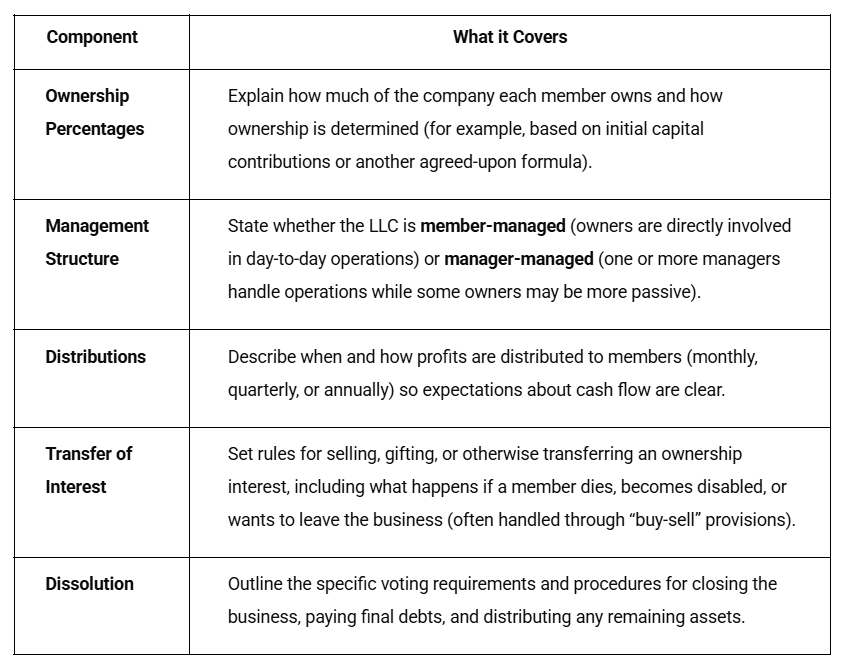
Small Business Considerations for Arizona LLCs
For Arizona small business owners, forming an LLC is an important step toward separating personal and business assets and positioning the company for potential tax benefits. However, simply filing Articles of Organization with the Arizona Corporation Commission is not enough; careful planning is needed to protect your rights and avoid future disputes.
Drafting a comprehensive Operating Agreement is essential. This document should clearly define the company’s structure, management roles, voting rights, and ownership interests, helping prevent disagreements as the business grows. Arizona business owners must also stay on top of state‑specific requirements, such as obtaining necessary licenses and permits, keeping accurate company records, and maintaining compliance with Arizona’s LLC statutes.
By working with a business attorney who understands Arizona’s LLC laws and requirements, small business owners can ensure their company is set up for long-term success. Glide Legal can provide guidance during the business formation process to help safeguard your interests, minimize the risk of disputes, and allow you to focus on building and managing your business with confidence.
2026 Legal Landscape
As of 2026, Arizona businesses use the Arizona Corporation Commission’s new online filing portal, Arizona Business Connect, for official business filings, replacing the prior eCorp system as of January 12, 2026. While you still do not file your LLC Operating Agreement with the state, maintaining a current, signed copy in your internal records is standard practice and often necessary to establish legitimacy with banks, lenders, and other third parties.
For more information, you can review the Arizona Limited Liability Company Act (Arizona Revised Statutes Title 29) or consult the Arizona Corporation Commission for formation and filing procedures.
Frequently Asked Questions About Operating Agreements in Arizona
Q: Does a single-member LLC need an operating agreement?
A: Arizona law does not require a written Operating Agreement, but it is strongly recommended even for a single‑member LLC. A signed agreement helps show that you are operating as a formal business, which can strengthen asset protection if you are ever sued and clarify how the business is owned and managed.
Q: What happens if we don't have an agreement and we disagree?
A: If you do not have an Operating Agreement, or if your agreement is silent on a particular issue, the Arizona Limited Liability Company Act’s default rules will govern your rights and obligations. In practice, this can lead to outcomes that do not match what the members expected and can make disputes harder and more expensive to resolve, sometimes requiring lawyers, mediation, or even court involvement. Sometimes the rules are unclear on a given issue, which makes the dispute much more difficult and less likely to resolve quickly.
Q: Does the agreement need to be notarized in Arizona?
A: No. An Operating Agreement does not have to be notarized to be legally effective in Arizona; it is generally sufficient that all members sign it. Some business owners still choose to notarize signatures to reduce the risk of later challenges or to satisfy the preferences of banks and other third parties.
Contact Glide Legal for a Free Consultation
Glide Legal is a Phoenix‑based business law firm serving small business owners and companies throughout Arizona. The firm focuses on helping employers and business owners with issues such as business formation, operating agreements, employment matters, and business litigation when disputes arise.
Attorneys Masar Mandwee and Alex Karam work closely with clients to understand their goals and provide practical, tailored solutions rather than one‑size‑fits‑all forms. If you are forming an Arizona LLC or need to update a multi‑member Operating Agreement, request a free consultation with a Glide Legal attorney to discuss your options and next steps.