Lending or borrowing money in Arizona? Learn the essential terms of a business loan agreement, Arizona-specific rules, and mistakes to avoid.
Lending money to a business, or borrowing it, often starts with a handshake and good intentions. Problems tend to surface later when circumstances change. If the repayment terms were never written down, the lender and borrower may remember the deal very differently: whether interest was owed, when payments were due, and what happens if the business struggles. A loan meant as a favor can turn into a dispute that strains a partnership, a family relationship, or a long-standing friendship.
Personal liability creates another layer of risk. An owner who signs a personal guarantee may be putting personal assets at risk, and a spouse may be asked to sign without fully understanding what that signature means. A lender who relies on a guarantee may discover it doesn't reach the assets it expected, especially if the guarantor is married and the spouse's role was never clearly defined.
A written business loan agreement helps clarify each party's rights and responsibilities, and certain transactions are legally required to be documented in writing under Arizona law. Whether you're extending credit or borrowing funds, understanding these risks upfront can help you avoid costly surprises. The sections below explain how Arizona law addresses these issues and what you can do to protect yourself.
Key takeaways
- Put it in writing. Arizona generally provides six years to sue on debt founded on a written contract executed in Arizona, measured from when the claim accrues. An otherwise enforceable oral debt generally has a three-year limitation period. Some commercial loan commitments must be in a signed writing to be enforceable.
- State the rate. Arizona generally permits any interest rate agreed to in writing for ordinary business loans, but contracting for or collecting unlawful excess interest can trigger forfeiture of interest.
- Secure it properly. Create an enforceable security interest and take the appropriate steps to perfect it. Perfection helps protect against competing creditors, but it does not guarantee first priority.
- Clarify the spouse’s role. When a married owner guarantees a loan and Arizona community-property law applies, the guarantee generally binds community property only if both spouses join it. That doesn’t mean every guarantee needs a spouse’s signature. Federal Regulation B limits when lenders can require one, and joining to make community property available is different from becoming personally liable.
- Have the documents reviewed. An attorney review can help identify unclear terms, missing signatures, and collateral issues before they become expensive disputes.
Why Written Loan Agreements Matter
Business loan disputes can begin with a handshake, a wire transfer, and two people remembering the deal differently a year later.
Maybe a co-owner is lending $50,000 to the company to cover payroll. Maybe a friend is lending your Phoenix startup money to buy equipment or perhaps your business is extending credit to a supplier or financing a buyer’s purchase of your company. In each case, the question is the same: if something goes wrong, what does the paperwork say?
In Arizona, those documents can affect the interest owed, the lender’s deadline to sue, whether personal or community assets can be reached, and the availability of attorneys’ fees.
At Glide Legal, our Phoenix business attorneys focus on contracts and transactions. This guide explains the terms and Arizona rules to consider before lending or borrowing business funds.
When writing is legally required
Written documentation is not merely a best practice. Arizona's statute of frauds, A.R.S. § 44-101, requires certain agreements to be in writing and signed by the party against whom enforcement is sought.
Three requirements are especially relevant to business loans:
- Commercial loans over $250,000: Under A.R.S. § 44-101(9), qualifying commitments to lend money or extend credit, including certain extensions, renewals, and modifications, generally must be in writing when the amount exceeds $250,000, and the financing is not primarily for personal, family, or household purposes.
- Personal guaranties: Under A.R.S. § 44-101(2), a promise to pay someone else's debt, such as a business owner's personal guarantee of a company loan, generally must be in writing regardless of the loan amount.
- Agreements lasting more than one year: Under A.R.S. § 44-101(5), agreements that cannot, by their terms, be fully performed within one year must generally be in writing.
The one-year rule is narrower than it sounds.
A loan doesn't automatically fall under this requirement simply because repayment takes longer than a year. What matters is whether the agreement's terms make completing it within one year impossible. For example, a repayment arrangement requiring payments over three years that does not permit earlier completion may fall within the rule. Exceptions can apply depending on the circumstances.
What about business loans under $250,000?
Smaller loans aren't automatically exempt from written agreement requirements. Personal guaranties and certain longer-term agreements may still require signed documentation. Loans secured by real estate also require appropriate written security documents, and a different interest rate generally must be agreed to in writing.
Even when an oral loan agreement is enforceable, proving its terms can be difficult, and Arizona generally provides less time to sue on an oral debt than on a written contract. A signed agreement remains one of the best ways to protect both parties.
What a business loan agreement does
A business loan agreement records the terms on which a lender advances or agrees to advance money to a business or business owner and the borrower agrees to repay it. It typically addresses the amount, interest, payment schedule, security, and each side’s rights if the borrower defaults.
Loan transactions may involve several documents:
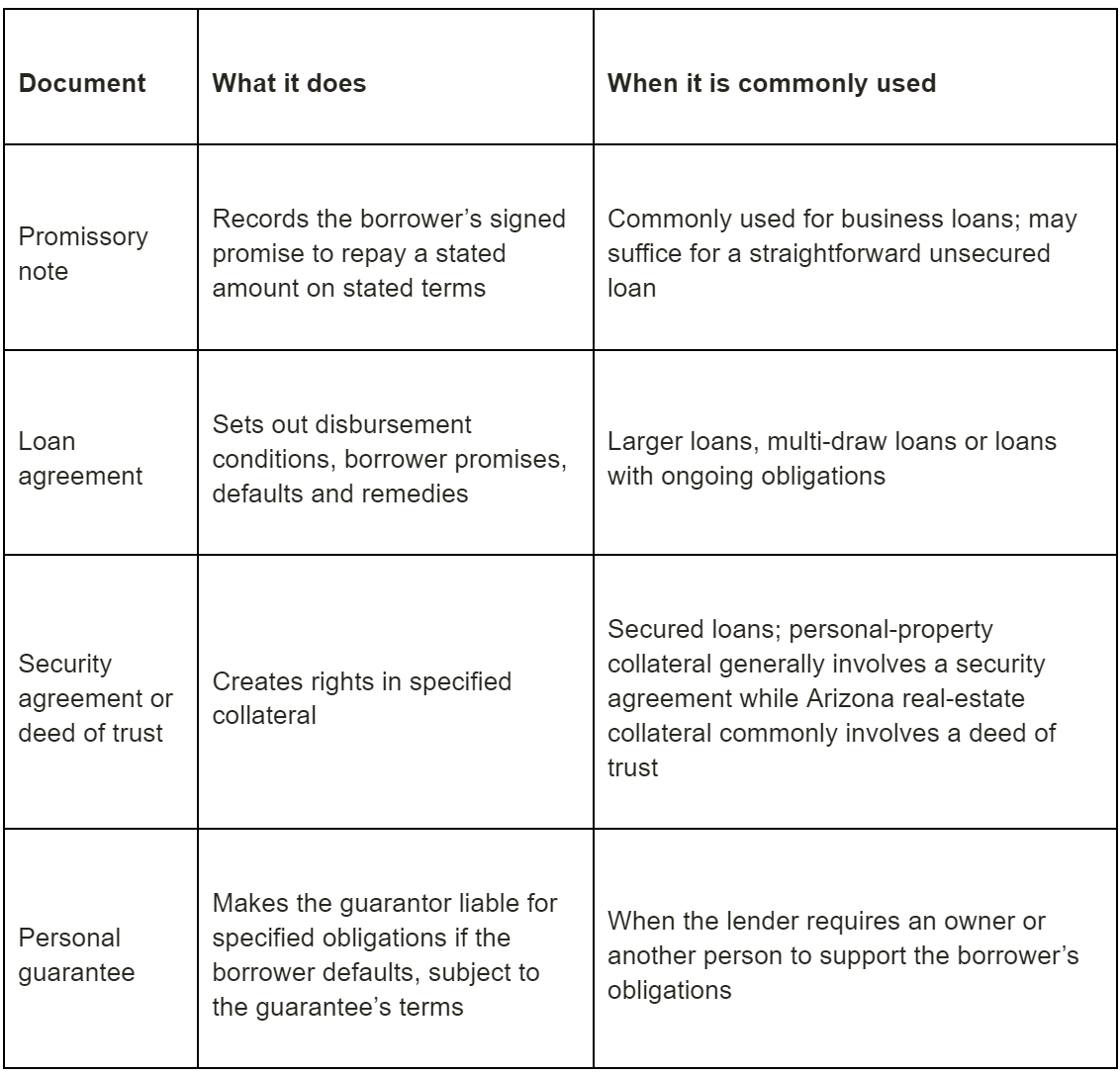
A straightforward loan between business partners may be documented with a well-drafted promissory note. As the amount, duration, or complexity increases, additional loan and security documents may be appropriate.
12 Essential Loan Agreement Terms
A well-drafted Arizona business loan agreement should address the following 12 subjects:
- Parties and signing authority. Use each party’s exact legal name. For entities, verify the name against the applicable formation or registration records and identify the signer’s title. If an LLC is borrowing, confirm the signer’s authority under its governing documents.
- Loan amount and disbursement. State the principal amount, whether funds will be advanced in a lump sum or through draws, the anticipated funding dates and any conditions that must be satisfied before disbursement.
- Interest rate. State the annual rate, whether it is fixed or variable and how interest is calculated. Address simple or compound interest, the day-count convention and any variable-rate formula. If the loan is interest-free, say so expressly.
- Repayment schedule. List payment amounts or the method for calculating them, due dates, the maturity date and where and how payments must be made. Identify any balloon payment.
- Prepayment. Explain whether the borrower may repay early and whether any prepayment fee applies.
- Late fees and default interest. State any grace period, late charge and default interest rate expressly. Putting these provisions in writing does not alone establish their enforceability; applicable interest rules and restrictions on contractual penalties still matter.
- Collateral. Identify the property securing the loan and use appropriate security documents. Determine the correct perfection method and filing jurisdiction rather than assuming that an Arizona transaction always requires an Arizona UCC-1 filing.
- Personal guaranties. Identify each guarantor and whether the guarantee is full, limited, or capped. If a guarantor is married and Arizona community-property law applies, decide whether community property needs to be available to satisfy the guarantee. If the spouse signs, state clearly whether the spouse is joining only to bind community property or is accepting personal liability. Lenders covered by Regulation B should confirm that any spousal signature they require is permitted.
- Borrower covenants. State ongoing obligations, such as providing financial statements, maintaining insurance, paying taxes, and obtaining consent before taking on additional debt or selling specified assets.
- Events of default. Define the conduct or circumstances constituting default, such as missed payments, material misrepresentations or breaches of covenants. Address applicable notice and cure periods.
- Remedies and acceleration. Explain when the lender may declare the remaining balance due and seek repayment, enforce collateral rights or pursue guarantors, subject to applicable law.
- Dispute resolution and other provisions. Address governing law, venue, court proceedings or arbitration, attorneys’ fees, notices, assignment, amendments and signatures.
A practical tip: attach an amortization schedule when appropriate. It helps clarify scheduled payments and projected balances, although variable rates, additional draws, missed payments, and fees can change the amount actually owed.
Arizona Rules That Affect Loans
Community Property and Guaranties
Arizona generally allows either spouse to manage community property, but guaranties are an exception. Under A.R.S. § 25-214(C)(2), both spouses must join a guaranty transaction for it to bind community property.
If only one spouse signs a personal guarantee, the lender generally can pursue that spouse's separate property, but not the couple's community property or the non-signing spouse's separate property.
What does a spouse's signature actually mean? Depending on how the agreement is written, a spouse may sign in different capacities:
- Joinder to bind community property: The spouse joins the transaction to make community property available for repayment without necessarily assuming personal liability against their separate assets.
- Personal guarantee: The spouse personally agrees to be responsible for repayment, potentially putting their separate property at risk.
A signature labeled "spousal consent" doesn't necessarily establish the intended scope of liability. The agreement should clearly explain what obligations each spouse is accepting.
Limitation periods
Arizona generally allows six years to sue on debt founded on a written contract executed in Arizona, measured from when the cause of action accrues. An otherwise enforceable oral debt generally has a three-year limitation period. A written instrument executed outside Arizona may be subject to a four-year period, depending on the applicable rules.
For installment loans, there may not be a single deadline measured from the first missed payment. Each unpaid installment generally has its own accrual date. When a loan includes an optional acceleration clause, effective acceleration can start the clock on the remaining balance; otherwise, future installments generally accrue as they become due.
Keep signed documents, funding records, payment histories and default and acceleration notices. Do not assume that signing in Arizona alone resolves every limitation-period issue.
Collateral and perfection
Creating an enforceable security interest and perfecting it are separate steps. An attached but unperfected security interest can be enforceable against the borrower. Perfection generally helps protect the lender against competing claimants, but priority depends on additional rules.
For personal-property collateral, filing a UCC-1 financing statement is common. However, the proper jurisdiction generally depends on the debtor’s location, subject to exceptions. Some collateral is perfected through possession, control, or another method rather than a standard financing-statement filing.
For Arizona real-estate collateral, a deed of trust generally must be properly acknowledged and recorded in the county where the property is located.
Attorneys’ fees
Under A.R.S. § 12-341.01, a court may award reasonable attorneys’ fees to the successful party in a contested action arising out of a contract. The statute does not make an award automatic.
Include a clear fee provision and explain whether it applies to collection efforts, litigation, arbitration, or other enforcement proceedings. Any recovery remains subject to the agreement and applicable law.
Practical Guidance: What each side should consider
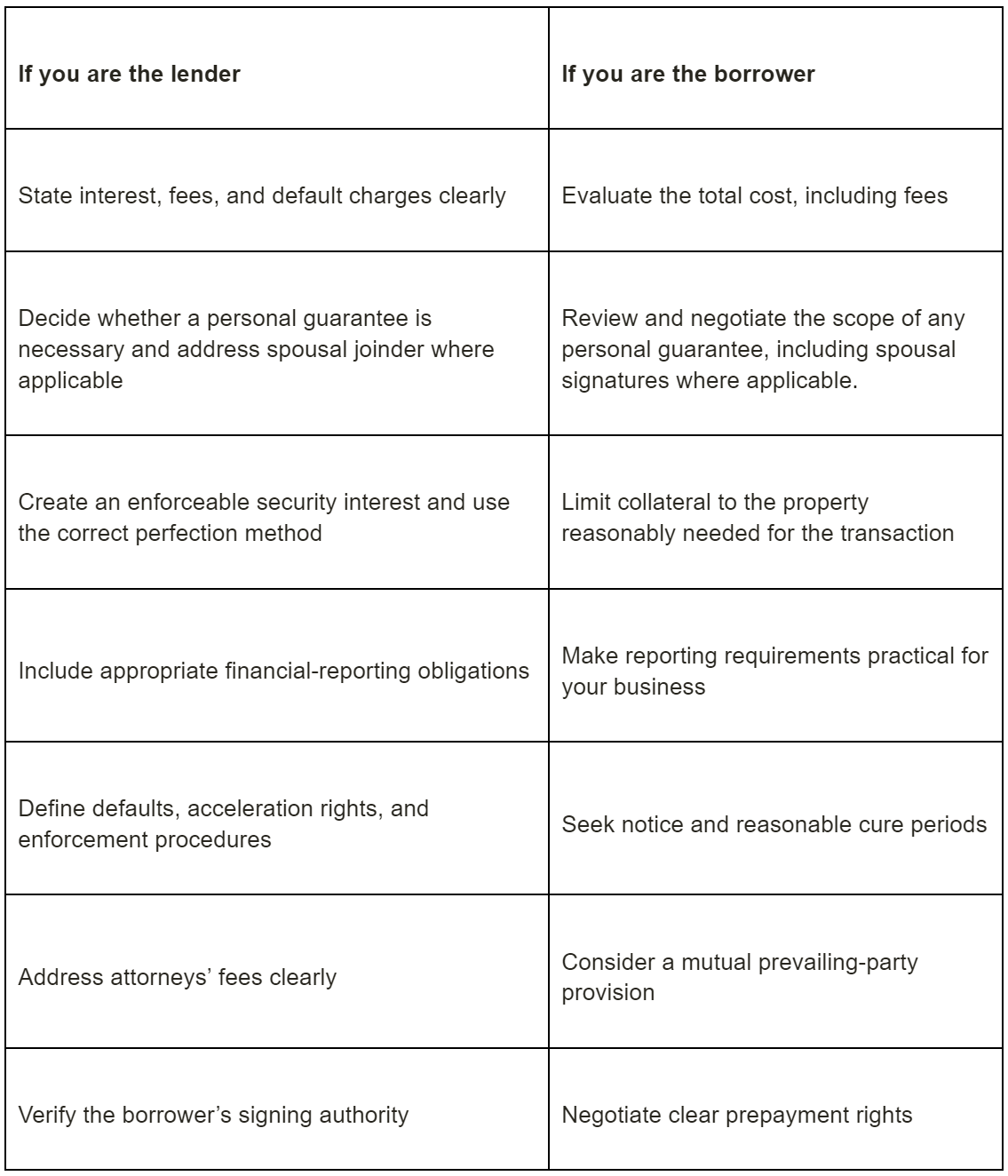
Loans between co-owners deserve additional attention. When an LLC member advances money to the company, document whether the advance is intended as debt or equity, follow the applicable approval procedures, and maintain consistent accounting records. A note and debt entry help establish the parties’ intent, but they do not guarantee how the advance will be treated in every later dispute.
How Glide Legal Can Help With Business Loan Agreements
Glide Legal works with Arizona businesses on both sides of these transactions, whether you're lending capital to another company, borrowing to grow your own, or reviewing a loan agreement someone else has prepared.
If you're lending money, Glide Legal can draft a loan agreement that clearly sets out the principal, the interest rate, and the repayment schedule, including installment or balloon structures. The agreement can also describe any collateral and spell out what happens if the borrower defaults, so you aren't left relying on vague terms when you need to enforce your rights.
If you're borrowing money or reviewing an existing agreement, an attorney can help identify potential issues before you sign, including unclear repayment terms, default triggers, prepayment restrictions, inadequate collateral descriptions, and provisions that may not reflect Arizona law. Glide Legal can also help you understand your obligations and identify terms that may be worth negotiating.
Glide Legal offers flat-fee pricing whenever possible. When a flat fee isn't practical, the firm provides an upfront estimate and tells you when to expect initial drafts or analysis before you hire it. Attorneys Masar Mandwee and Alex Karam serve businesses throughout Arizona.
If you're preparing to lend or borrow money, or you've been asked to sign a guarantee, learn more about Glide Legal's business loan contract services or request a free consultation to talk through your transaction before you sign.
Before You Sign: A Practical Checklist for Business Loans
Whether you're lending or borrowing money, reviewing a few important details before signing can help prevent costly disputes. Here are six things to verify before moving forward.
1. Confirm Who You're Dealing With and Who Can Sign
Verify the business's legal name and confirm that the person signing has authority to enter the agreement. Arizona corporations and LLCs can be researched through the Arizona Corporation Commission.
For larger transactions, review the company's governing documents and obtain any necessary approvals. The agreement should also clearly establish whether someone is signing on behalf of the business, personally, or both.
2. Review the Full Repayment Obligation
Make sure both parties understand:
- Interest rates, late fees, and other charges.
- Payment deadlines, maturity dates, and balloon payments.
- Prepayment rights and potential penalties.
- Events of default and the lender's available remedies.
Borrowers should understand their total financial obligations, while lenders should ensure repayment and default provisions are clearly documented.
3. Check Collateral and Existing Liens
For secured loans, verify who owns the collateral and whether other creditors already have claims against it.
Review applicable UCC filings for business property or county recording records for real estate. Existing liens can affect a lender's ability to recover funds, while borrowers should confirm that pledging the assets won't violate existing agreements.
4. Understand Personal Liability
If the loan includes a personal guarantee, determine whether liability is limited, whether future debts are covered, and whether the lender can pursue the guarantor directly.
For married guarantors, make sure the documents clearly establish the purpose and scope of any spousal signature, as discussed earlier.
5. Complete the Necessary Documents and Filings
A straightforward unsecured loan may only require a properly drafted promissory note. More complex transactions may require additional loan documents, security agreements, or personal guaranties.
For secured loans, lenders should also ensure that any necessary steps to perfect their security interests are completed and that applicable filings are maintained or terminated when appropriate.
6. Distinguish Owner Loans From Investments
When a business owner advances money to their company, clearly document whether the funds are intended as a loan or an equity contribution.
If the advance is a loan, establish repayment terms, obtain any required approvals, and maintain consistent accounting records. This helps establish the intended arrangement and avoid future disagreements.
Frequently asked questions
Does the agreement need notarization?
A business loan agreement or promissory note generally does not need notarization merely because it documents a loan. A deed of trust generally must be properly acknowledged for recording.
What is the maximum interest rate?
For ordinary business loans governed by A.R.S. § 44-1201(A)(2), the parties may generally agree in writing to any interest rate. Separate rules can apply to regulated loans. The statute’s 10% default rate does not necessarily impose contractual interest on an oral loan intended to be interest-free.
Is a promissory note enough?
A well-drafted promissory note may be enough for a straightforward unsecured loan. Additional documents are appropriate when the transaction includes collateral, multiple advances, conditions to funding, ongoing covenants, or personal guaranties.
Does my spouse need to sign?
Not automatically. A spouse's signature most often becomes an issue when a business owner personally guarantees a loan.
Under Arizona law, both spouses generally must join a guaranty for it to bind community property.
If your spouse is asked to sign, make sure the agreement clearly distinguishes between making community property available for repayment and assuming separate personal liability.
How long does a lender have to sue?
Generally, six years for debt founded on a written contract executed in Arizona and three years for an otherwise enforceable oral debt, measured from accrual. Installment payments and acceleration can affect when particular claims accrue. Written instruments executed outside Arizona may be subject to different rules.
Can I lend money to my LLC?
An owner’s advance should be documented and approved under the company’s governing documents. If the advance is intended as a loan, use clear repayment terms and consistent accounting records to help establish that it is debt rather than equity.
What happens after default?
The agreement and applicable law determine the available remedies. The lender may be entitled to accelerate the balance, enforce collateral rights, pursue guarantors, and seek reasonable attorneys’ fees. Clear documents help establish those rights, but fee recovery is not automatic.
Talk to an Attorney About Your Business Loan
Whether you're preparing to lend money, reviewing a lender's loan agreement, or trying to document a loan that's already been made, understanding your rights and obligations can help prevent costly disputes.
An unclear repayment provision, improperly documented collateral, or an overly broad personal guarantee can create significant financial risks.
Glide Legal's Phoenix business attorneys help Arizona businesses draft and review loan agreements, understand their obligations, and identify potential issues before they become expensive problems.
If you're lending or borrowing money, call (602) 902-1395 or request a free consultation to discuss your agreement and the next steps for your business.